
Governance-first AIPlanet Crust @Human: The Sovereign AI Enterprise System
Build compliance-led AI agents, automations, and applications
With @Human, you can build AI agents, automations, and applications that follow the rules from day one. Safety and governance come first. Every system is ready for the EU AI Act, ISO 42001 and GDPR. Use @Human to create AI agents, automations and business systems that are safe and follow the law from the start.
- EU AI Act
- ISO 42001
- GDPR
- AI safety first
- Self-hosted
- Any AI model
- EU AI Act
- ISO 42001
- GDPR
- AI safety first
- Self-hosted
- Any AI model

Trusted byOrganisations building secure applications
@Human For EnterpriseCore systems, governed by design
Run your core enterprise applications on governed AI
Finance, insurance and CRM are where AI pays off fastest, and where good decisions matter most. @Human builds these systems with policies, approvals, guardrails and evidence from the first line, on infrastructure you control.

Finance operations
Payables, approvals, spend and month-end close, with invoices matched by rules and anomalies explained.
- Three-way matching runs as token-free automation
- Payments over limit need a named approver
- Every anomaly is explained before anyone pays

Claims and complaints
Claims intake, explainable fraud signals, settlement and Consumer Duty reporting in one governed system.
- Explainable signals with transparent scoring
- Vulnerable customers routed to a named handler
- Complaints and outcomes ready for the board pack

Accounts and pipeline
Pipeline, accounts, contacts and forecasts, with account briefs drafted for the owner and consent checked on every send.
- Consent checked by rule before every email
- Account briefs drafted by AI, owned by people
- Renewals and stale deals chased automatically
Plus HR and workforce, service desks, procurement and any system your teams need, each one a governed project with signed approval gates, runtime guardrails and EU AI Act and ISO/IEC 42001 evidence.
Beautiful applications, with the governance built in
These screens come from projects built on @Human: maps, dashboards, rosters and portals your teams and the public actually use.
Enterprise-grade software, ready for production
Full applications with data models, pages, workflows, agents and dashboards, each one a governed project from its first line.


Example applications with illustrative data. Dashboards are native @Human charts.
Built for teams and communities
Apps for the people you serve, with protections that come from the governance record itself.

Biodiversity Watch
Citizens report poaching, pollution and illegal logging on a live map. Rangers verify reports and plan action.

Programme Impact
Monthly returns become board-ready charts and insights, every figure traceable to a reviewed, locked return.

Ward Rostering
Shifts, attendance, leave and corrections for hospital wards, with decisions surfaced to the right manager.

Every application is a governed project
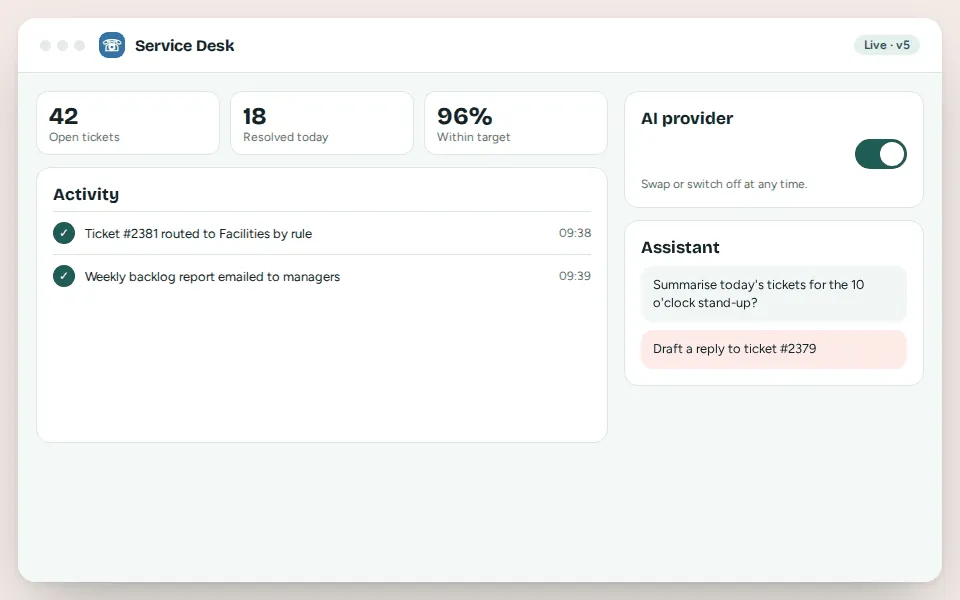
Service desks, accounting, classrooms, content calendars and risk checkers live side by side, each with its own policies, risks and approvals.
Dashboards your board will actually look at
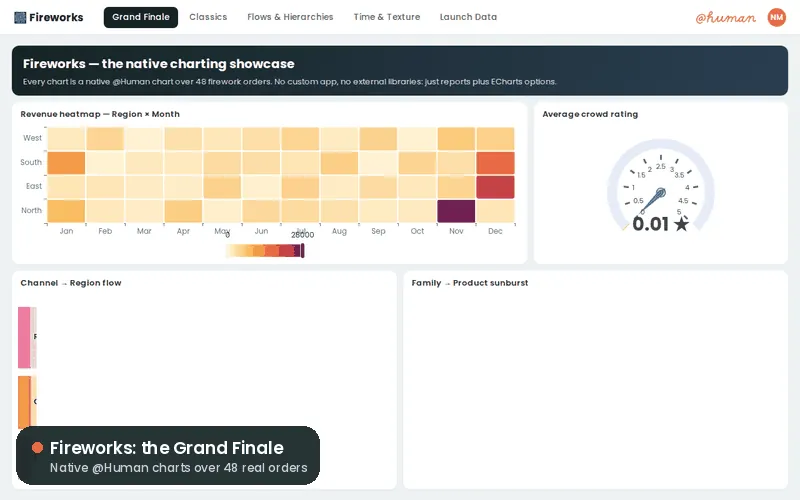
Every chart here is a native @Human chart, built from reports over a single module of 48 orders in our Fireworks showcase. Point-and-click, and included in @Human: heatmaps, Sankey flows, sunbursts, treemaps, ThemeRivers, calendars and every classic chart, all governed like the rest of the app.


Introduction to @Human by Planet Crust · 1:06
So we built AI the other way around.
One minute on governance first, tested automation, and keeping your data with you. It's subtitled, so it plays with the sound off. The rest of this page explains each part.
Read the transcript
Somewhere tonight, an AI made a decision. It approved a payment. It flagged a patient. It answered a customer. Nobody signed it. Nobody saw it. Tomorrow, someone will have to explain it. AI is moving faster than the people who are responsible for it. So we built it the other way around. @Human, by Planet Crust.
Your rules are written before a single screen is built. Your risks are mapped. Your data is accounted for. Then you build agents, automations and whole applications. Proposed changes are always checked against your governance, and flagged for review whenever necessary.
AI does the hard thinking once. After that, the work runs as tested automation: the same result every time, without paying for tokens on every run. Your data stays in your infrastructure. You choose the model. And if you ever want to leave, you can always unplug.
Because the future of AI isn't artificial. It's accountable. AI can propose. People decide. That's why we called it @Human. @Human, by Planet Crust.
Your AI is moving faster than your governance
Teams buy one tool to build AI and another to document it. Developers ship on Monday and the risk register catches up next quarter. Bringing both together is how audits go smoothly and projects move faster.
The top EU AI Act penalty
Of worldwide annual turnover, whichever is higher, for prohibited AI practices. Most other breaches can reach €15m or 3%.
One gap in the middle
Governance suites document AI built elsewhere. App builders leave governance to admin settings. @Human keeps the two in step.
Is a chance to drift
A new field, prompt or permission can quietly change your risk. Keeping the record updated keeps your evidence current.
Penalty figures from Article 99 of Regulation (EU) 2024/1689, the EU AI Act.
Three promises built into every @Human application
Most platforms promise speed. We promise control: over risk, over cost, and over who you depend on.
Everything goes live governed.
Policies, the sensitive data register and rights-based risk scenarios come before the build. Named people sign every release, and approval and publishing always stay with them.
You pay a model only for fresh thinking.
AI helps you build. The app then runs on tested, programmatic automation wherever the choice exists, so routine work runs token-free and behaves the same every time.
You can always unplug.
You are free to use any AI provider. Switch models in place, or disconnect AI entirely, and your forms, rules, records and reports keep running.
Better results, built securely and cost-effectively
Three things set @Human apart: compliance comes first, proven code does the heavy lifting, and every application is built from your specification.
- ✓Policies written and owned
- ✓Sensitive data register complete
- ✓Risk scenarios for harms and benefits
- ✓Governance owner signed
- ✓Data protection officer signed
- …Executive authority to sign
Compliance first
Policies and risk management are built in. A sensitive data register and rights-based risk scenarios are in place before anything is built, every proposed change is checked against them, and only people can approve and publish.
Proven code, fewer tokens
@Human builds from pre-established, tested code instead of generating it from scratch. That means stronger security and much lower token costs.
Data sovereignty
Software you run, on your terms. Your data stays in your infrastructure, with any AI provider you choose.
Built from your specification
Describe what you need and @Human builds it as a native or custom application, designed around the people who use it. 100% open source.
Stable from day one
Pre-testable in a draft, predictable in production, with every version kept on record.
From AI idea to compliant, live system in three steps
The same discipline every time: propose, confirm, approve. AI can help with the work; people make the decisions.
Classify and set the rules
Describe the AI system and its purpose. @Human classifies it against the EU AI Act and ISO/IEC 42001, then you set policies, the sensitive data register and risk scenarios.
Governance exists before the buildBuild it governed
Create the data model, pages, automations and AI assistants in the same project. Every change raises an impact review against your rules.
Programmatic first, agents where neededApprove, run and prove
Named people sign the approval gates. Once live, event logging, incident tracking and alerting keep the evidence current for your auditors.
Evidence that stays trueBring a use case to a 20-minute walkthrough and see it built, classified, logged and reported inside @Human.
Governance is how every application gets built, from the very start.
Every @Human application is a governed project that moves through six stages. Your risk register and policies exist before the first screen is designed, and your compliance evidence builds itself as you go.
- SetupPeople, roles, approval gates and providers
- Policies and riskWritten before anything is built
- BuildData, pages, automations, assistants, apps
- GovernRisk re-checked against what was built
- ManageIncidents, requests, reviews and reports
- ComplyEU AI Act, ISO/IEC 42001 and GDPR evidence

- Rights-based risk assessmentHarms and benefits assessed against the EU Charter of Fundamental Rights (FRIA), plus any sector rules you answer to.
- A data map that follows data into AIEvery place personal data lands, including prompts, assistant memory and AI outputs.
- Versioned policies and privacy noticesOwners, clause history, and end users re-accept when it changes.
- Field-level permissionsDecide who sees each field, down to "only their own records".
AI can propose. People decide. AI prepares work in @Human, and named people approve and publish every release.
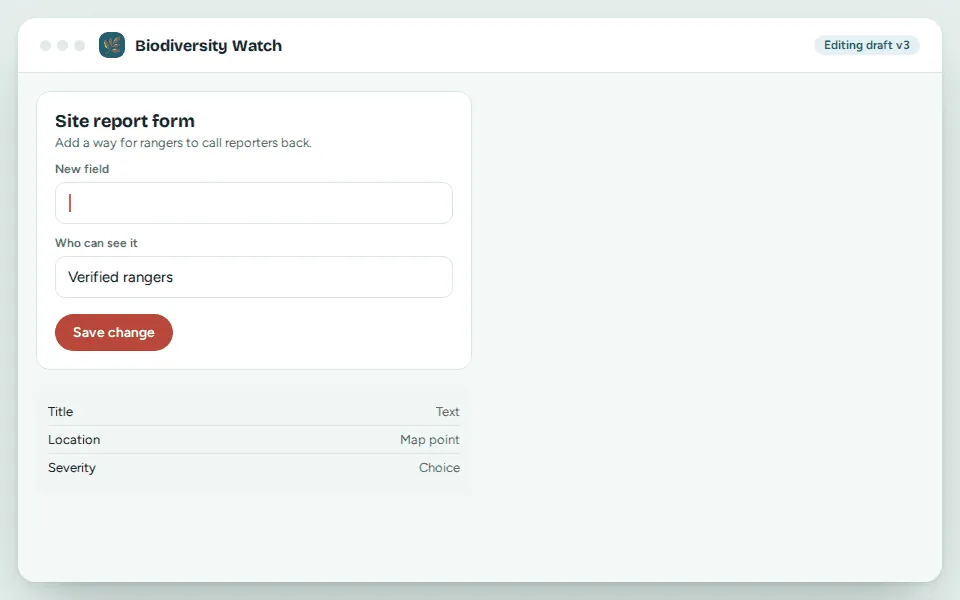
Propose a change. Governance checks it first.
Proposed changes are always checked against governance, and reviews are flagged whenever necessary. Propose an edit to a form, an automation, an assistant or a permission, and @Human checks it against your policies, register and risk scenarios before it can go live.
- New personal data becomes a register entryWith its purpose, retention and who can see it.
- New purposes call for new risk scenariosAssessed and settled before release.
- The privacy notice is re-versionedUsers re-accept it where the change affects them.
Spend AI on thinking, and let automation handle the repeats
Many AI platforms run your business process through an agent that calls a model every single time. @Human uses AI to help you build, then favours programmatic automation wherever the choice exists. Lower LLM token costs, and behaviour you can test before it reaches anyone.
Agent-first automation Common elsewhere
A model decides what to do, every time it runs.
- Tokens billed on every run, so costs grow with use
- Can answer the same input differently
- Hard to test fully before going live
- Stops when the model or provider is unavailable
Programmatic first @Human
AI helps design the automation. The automation then runs on its own.
- Token-free routine runs
- Same input, same result, every time
- Pre-testable in a draft before release
- AI agents kept for tasks that need judgement
Where the token bill comes from
With an agent, every run is billed. With programmatic automation, AI is used while you build and routine runs are token-free.
Illustrative only. Actual costs depend on your model, provider and volumes.Pay for AI where it adds judgement, and run routine steps as automation.
Automations and permissions are tried in a draft version first.
Predictable behaviour your team and auditors can rely on.
Where both would work, @Human picks the one you can test.

Your AI, your choice. And your systems keep running whatever you choose.
Sovereignty means freedom to choose any AI. Choose any model or provider, change your mind later, or unplug AI completely. Your forms, rules, records and reports carry on.
- Free choice of AI vendorEU-hosted, hyperscaler or open models, switched in place, with the app intact.
- Operational if unplugged from AICore processes run as programmatic automation, so your service keeps running through any outage or policy change.
- Software you run, on your termsInside your own infrastructure and security controls. Your production data stays entirely with you.
Free 20-minute governance walkthrough
Bring a use case you're planning, and leave with a clear picture of how to build it compliance-first.
- How it would be classified under the EU AI Act
- Which ISO/IEC 42001 controls it touches
- How it would be logged, monitored and reported
- Where you could cut token costs
Build once. Reuse with confidence.
An @Human app is a clear set of parts you can read, test, version and carry into the next project.
Parts you can see
Data models, pages, charts, automations, assistants and custom web applications. 100% open source.
Every version kept
Work happens on a draft. Approved versions go live, and earlier versions stay on record for audit and roll-back.
Governance you can reuse
Policies, risk frameworks and data register patterns from one project become the starting point for the next.
One platform for building and governing
AI governance tools document AI built somewhere else. AI app builders leave governance to admin settings. @Human closes the gap.
Swipe the table to see all columns.
| Capability | AI governance tools | AI app builders | ![]() |
|---|---|---|---|
| Builds the app: data, pages, automations, assistants | — | Yes | Yes |
| Policies and risk written before the build | Separately | — | Yes |
| Rights-based risk assessment (FRIA) | Yes | Rarely | Yes |
| Data register down to prompts and AI memory | Partly | Partly | Yes |
| Re-review triggered by every change | — | — | Yes |
| Human approval gates before go-live | Partly | Partly | Yes |
| Runs with AI connected or disconnected | — | Varies | Yes |
| Open source, self-hosted, any AI model | Rarely | Varies | Yes |
@Human supports your compliance evidence; conformity remains the responsibility of the organisation deploying the AI.
Made for organisations that answer to someone
Regulators, boards, funders, patients, citizens. If someone will ask how your AI was governed, @Human gives you the answer.
Public sector
EU AI Act high-risk duties, fundamental rights impact assessments and in-country hosting.
Case triage, citizen servicesHealthcare and social care
Special-category data, patient safety and DPO scrutiny, with the register following data into AI.
Rostering, referral triageFinancial services
Model risk, consumer duty and auditability through approval gates and versioned policies.
Claims intake, complaintsEducation
Minors' data, safeguarding and fairness, assessed with vulnerable groups in mind.
Classrooms, learner supportNGOs and charities
Funder and donor rules as custom risk frameworks, at a cost that fits the budget.
Programme reporting, beneficiariesManaged service providers
Governed AI for every customer, with many projects on one instance.
Service desks, knowledge assistantsWant your legal, risk and data protection teams to say yes to your next AI project?
Pay what you can. Seriously.
@Human is open source and the whole platform is yours, whatever you pay. Every module, unlimited users and agents, at every amount.
a month
If it saves you more than it costs and you want the roadmap to keep moving.
Start at €25Need more than the forum? Support plans add our team's time on top of the full feature set: Advanced from €2,000 a month and Enterprise from €5,000 a month, billed annually. Prices exclude VAT.
Questions about the Sovereign AI Enterprise System
What enterprise, risk and compliance teams ask before they build AI agents, automations and applications with @Human.
What is @Human?
@Human is the Sovereign AI Enterprise System from Planet Crust. Enterprises use it to build safe compliance-led AI agents, automations and applications that follow the rules from day one. Safety and governance come first: every system is ready for the EU AI Act, ISO 42001 and GDPR, and for the laws of any country you operate in.
Which laws and regulations does @Human support?
Any that apply to you, in any country. The EU AI Act, ISO/IEC 42001, GDPR, UK regimes and the EU Charter of Fundamental Rights are built in, and you can add any national law, sector regulation, code of practice or internal policy as your own framework. Every AI system is then assessed and controlled against each one before anything is built, and the evidence builds as you go. See how the law comes first.
How is @Human different from AI governance software?
Most AI governance and GRC tools document AI that was built somewhere else. In @Human, the application is built, governed and evidenced in the same project, so accountable roles, approval gates, runtime guardrails and monitoring stay in step with the system. Explore @Human Enterprise.
Can AI agents approve their own work?
No. AI agents can prepare work and request approval, but only people holding an accountable role can sign approval gates and publish versions. Every agent action, decision and change is written to the event log.
Where does @Human run, and where does our data stay?
@Human runs on your own cloud, private cloud or servers, or hosted in an EU region. Your production data stays in your own estate, inside the security controls you already have. Read about trust and security.
Which AI models can we use?
Any provider, including EU-hosted and open models such as Mistral, and you can switch in place. Core processes keep running with AI switched off, so you are never locked in to one model vendor.
Is @Human an alternative to Salesforce Agentforce?
Yes. @Human is an open-source alternative to Agentforce: it works with any AI model, runs on infrastructure you control and supports unlimited users, agents and automations, with approval gates and guardrails around every agent. Compare the approaches.
Which sectors is @Human built for?
Regulated organisations in any country: the public sector, healthcare and social care, financial services and insurance, education, managed service providers and not-for-profits. @Human is built on an open-source platform that has run in production with enterprises, governments and NGOs for years. Find your sector.
Is @Human open source, and what does it cost?
Yes. @Human is 100% open source, so your security team can read and verify the code. Pricing is pay what you can, from €1 a month, with every feature in every edition. Support plans start at €2,000 a month for organisations that need response times and compliance help. See plans and pricing.


